
See also
| Name: | James Jones HOMEYARD1 |
| Sex: | Male |
| Father: | William HOMEYARD (1845-1907) |
| Mother: | Fanny UNKNOWN (1842?-1935) |
| Birth | 28 May 1872 | Exeter St Thomas, Devon, England1 |
| Baptism | 11 Aug 1872 (age 0) | St Thomas, Devon, England |
| Alphington Street | ||
| Census | 3 Apr 1881 (age 8) | Exeter, Devon, England1 |
| 9 Okehampton Street, St Thomas | ||
| Occupation | 3 Apr 1881 (age 8) | scholar; Exeter, Devon, England1 |
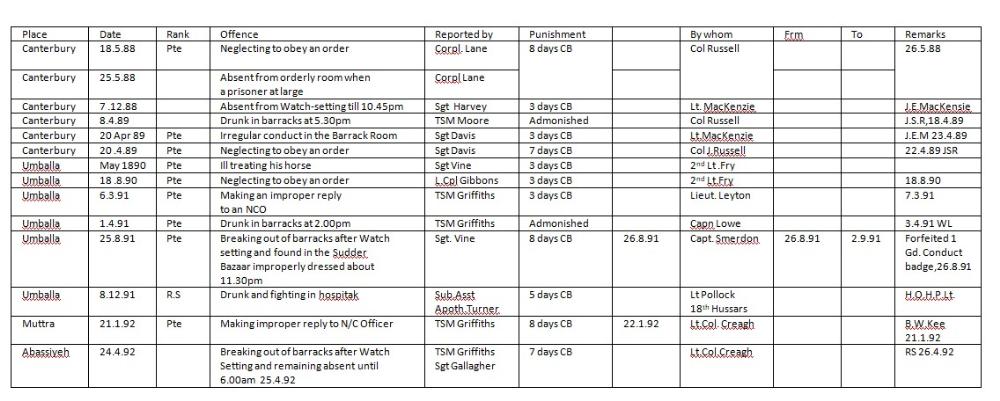
| Military Regiment | 7th Dragoon Guards, 1st Class Army Reserve | |
| Military Rank | Private | |
| Military Service No. | 3582 | |
| Enlisted (Military) | 6 Oct 1887 (age 15) | Taunton, Somerset, England |
| Transferred (Military) | 9 Nov 1894 (age 22) | St Thomas, Exeter, Devon, England |
| 8 Okehampton Street Army Reserve 7th Dragoon Guards |
||
| Discharged (Military) | 2 Oct 1899 (age 27) | Canterbury, Kent, England |
| Enlisted (Military) | 1 Nov 1899 (age 27) | |
| (Re-enlisted), 1st Class Army Reserve, 7th Dragoon Guards | ||
| Posted (Military) | 1900 (age 27-28) | S.Africa |
| Posted (Military) | 6 Jun 1902 (age 30) | Home |
| Eyes (Military) | light blue | |
| Hair (Military) | brown | |
| Marks/Scars (Military) | No scars, three vaccination marks on left arm, complexion fresh. | |
| Height (Military) | 5ft 11ins | |
| Weight (Military) | 149lbs | |
| Death | 28 Jun 1903 (age 31) | Hampstead Heath, London, England |
| Cause: suicide while of unsound mind He shot himself with a revolver on Hampstead Heath. Inquest Held 2 July 1903 |
||
Central London Coroner's Office, 20 Brunswick Square, W.C. 3rd July 1903
Certificate of Identity Private James Jones Homeyard herewith enclosed.
Deceased committed suicide by shooting himself with a bullet from a revolver being found dead on 28 June 1903on Hampstead Heath
Verdict of Jury
Suicide when of unsound mind.
George Danford Thomas M.D.
H.M.Coroner
The Weekly Despatch. 5 July 1903
DRAGOON’S SAD SUICIDE
A FRUITLESS SEARCH FOR WORK
The particulars of a particularly shocking suicide were detailed in evidence given at an inquest held by Dr. G.Danford Thomas at Hampstead on the body of James Jones Homeyard, thirty-one, an ex sergeant in the 7th Dragoon Guards. Deceased’s mother, who resides at Exeter, said her son returned from South Africa in June 1902 and took part with his regiment in the King’s Coronation procession. He left Exeter for London in search of work, which he failed to find. He was an active man, and chafed under his enforced idleness. The Hon. Robert Ward, brother of the Earl of Dudley, and the deceased’s former officer, had maintained her son in London, and did his best to secure him employment. The deceased grieved to be a burden to anyone.
Thomas Dodd, valet to the Hon R.Ward , stated that his mater was on General Broadwood’s staff, and took great interest in the deceased, both in South Africa and since his return to England. Mr. Ward did his best to get deceased work, and paid his expenses.
A PITIFUL LETTER
Police Constable William Carr (212S) deposed that at 7.30 a.m. on Sunday he discovered the deceased lying dead in some bushes near Tooley’s Farm, North End, Hampstead Heath. Beside him was the six-chambered revolver produced, three chambers of which were discharged. In his possession was found an open letter, in which he had written:
I have not, up to the present, received my medals, which were hardly won. My most sincere regret for the trouble and worry I have caused to the Hon. R.Ward, to say nothing of considerable expense, which I hope to cut short before tonight is over, for which I hope he will forgive me. I came to London about eight months ago, quite willing to work for my living, and I have not done anything since, and I do not see any prospect of getting anything. I have been thinking of this way out of it for some time. . . .
I have had some trouble dragging on for some time. It would have been better if I had never come to London. Well, such things will happen, and I hope that whoever finds my miserable carcase will forgive me for any trouble I may put them to. God help my poor parents.—J.J.H
Dr. Payne deposed that death was due to a revolver shot through the right temple. The jury returned a verdict of “Suicide while of unsound mind”.
A SAD END
The tragic death of Homeyard, the cabman, who was formerly such a familiar figure at St. David’s Station, was a shock and surprise to Exonians generally, and to his brother Jebus in particular. He wasa man who, under all conditions, displayed such a happy and lively temperament, that the news of his sad end could scarcely be credited by those who knew him. Homeyard, who formerly belonged to the 7th Dragoon Guards (the Black Horse) was an ideal cavalryman, standing six feet high and of fine physique. When the Boer War was at its height Homeyard went to the front where he took an active part in the operations against our late ubiquitous foe. The end of the South African trouble found him again in civil life, and, not being able to find employment in Exeter, he betook himself to London, where he accidentally met the Hon. Robert Ward , who was Captain of his troop in South Africa. This gentleman seems to have greatly befriended the unfortunate trooper, but after eight months unsuccessful search for employment, and “sincere regret for the trouble and worry I have caused to the Hon. R.Ward” – as he expresses it in his final letter—he put an end to his life on Hampstead Heath.
+ + + + + +
Commenting on the above incident, a correspondent writes:-- “ The bad luck of ex-Sgt. Homeyard in not finding employment is the fate of scores of Reservists in Exeter at the present moment. In fact, instead of being encouraged in their laudable endeavours to find civil employment, these men, fresh from the colours, seem to be looked upon as mere ‘undesirables,’ and the bare mention of their coming from the Army seems to be s prominent reason for their rejection by labour employers. When, may it be asked, will the authorities awake to their stupendous responsibilities in regard to the time-expired soldier and reservist?”
Hampstead and Highgate Express, Saturday, 4 July 1903
SUICIDE ON THE HEATH
A BRAVE SOLDIERS SAD DEATH
ON Thursday Dr. G. Danford Thomas held an inquiry at the Hampstead Provident Dispensary Hall, New End, into the circumstances surrounding the death of James Jones Homeyard, aged thirty-one, late of the 7th Dragoon Guards, whose home was at Exeter and who committed suicide by shooting himself with a revolver on Hampstead Heath on Sunday last.
Mrs Fanny Homeyard, wife of William Homeyard, a labourer, of St. Thomas’s, Exeter, said her son the deceased had been to the war in South Africa, and returned in June, 1902, to take part in the Coronation proceedings. He had been a sergeant in the 7th Dragoon Guards. She last saw him at Christmas when he went home. He was then very cheerful though he had not succeeded in getting any work since he left the Army about eleven months ago. The Hon. Robert Ward, an officer in the regiment, had been keeping him and he had been trying to get work. She never thought he was likely to take his own life. He had never spoken despairingly.
Thomas Dodd, valet of 7 Carlton Gardens, said he was with the deceased in South Africa. The Hon. Robert Ward (witness’s employer) had been keeping him and getting him work. Witness last saw him on the previous Thursday. He was then all right and witness had never known him to be despondent.
PC Carr 212 S, said that on Sunday morning, about 7.30, he was told that a man had been found dead on the Heath near Mr. Tooley’s farm. He went to the spot and found the body of deceased lying there, with a revolver between his legs. It was a six chambered revolver and three chambers were discharged. There was also a bottle of gin. He took the body to the mortuary, and, on searching it, he found a cartridge box with twenty-five cartridges and a written statement.
The coroner read the statement. In this the deceased gave his name, and said he had served with some credit and distinction, being for months on Gen. Broadwood’s headquarter staff. After the latter left the column for home he was left in the same position for Col. H. De B. De Lisle, who promoted him to the rank of Brigade Provost Sergeant, which he held until Col. De Lisle left the column. He was one of the regiment finally selected to come home to represent the regiment at the Coronation which did not come off. He had not, up to the present, received his medals which were hardly won. The deceased then went on to express his sincere regret for the trouble and worry he had been to the Hon. R.A. Ward to say nothing of the considerable expense, which he hoped to cut short before that night was done, and for which he hoped Mr. Ward would forgive him. He went to London about eight months ago, quite willing to work for his living, but had not been able to get anything and could not see any prospect of getting anything. He had been thinking of that way out of it for some time. He concluded with the words, “ It would have been better if I had not come to London, but such things will happen. God bless my poor parents.”
David Watling, coroner’s officer, said the Hon. Robert Ward had tried hard to get the deceased a good job, and had received a communication with that end in view from a gentleman on Monday. The reason he took such an interest in the man was that he said he was such a plucky fellow in the field—the more shot and shell there were about the better he seemed to like it. Mr. Ward had paid for his board and lodging, given him pocket money, and told him not to worry, as he would soon be able to get something to do.
Mr. W.H.Payne, of Gayton Road, police divisional surgeon, said he was called to the deceased on Sunday morning. He found there was a wound in the right forehead exposing the brain. The bullet had gone downwards and fractured the base of the skull. Death was due to fracture of the skull and injury to the brain, and would be instantaneous. Witness added that the deceased was a very finely built man.
Francis Sole, of York Street, St James’s Square, with whom the deceased had been lodging, said the latter had always been a sober, temperate man. He had tried hard to get work.
The jury returned a verdict to the effect that the deceased committed suicide while in a state of temporary insanity brought on by distress of mind through inability to get employment.
We are informed that the Hon. R.A.Ward has paid all funeral expenses, including the purchase of a private grave for the deceased.
| 1 | (RG11/2144; Folio: 84; Page: 28). |
| Text From Source: Census England 1881 Address: 9 Okehampton Street, St Thomas Place: Exeter, Devon, England Name,Relation,Condition,Sex,Age,Occupation,Where Born,Infirmity William Homeyard,Head,Mar,M,36,general labourer,Dunsford, Devon, England, Fanny Homeyard,Wife,Mar,F,38,,Chittlehampton, Devon, England, Henry F Homeyard,Son,Unm,M,12,scholar,Exeter St Thomas, Devon, England, Fred S.J. Homeyard,Son,Unm,M,10,scholar,Ide, Devon, England, James Homeyard,Son,Unm,M,8,scholar,Exeter St Thomas, Devon, England, |